
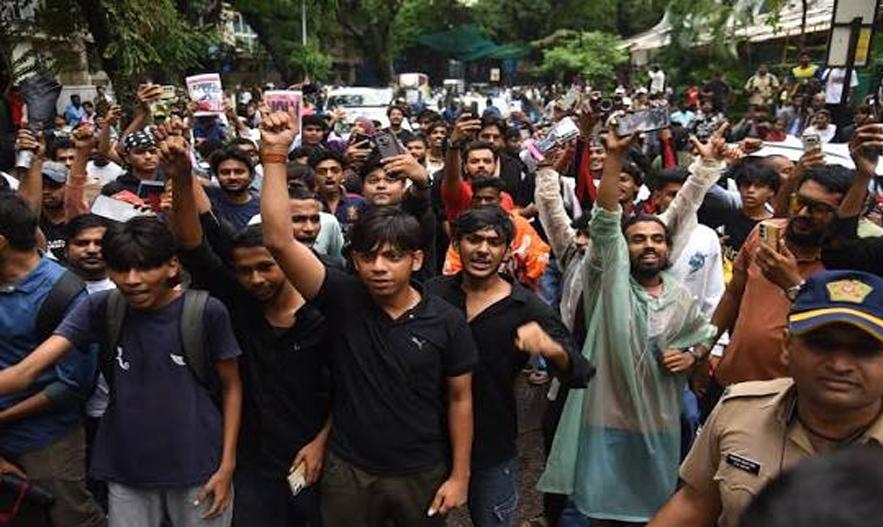
The Centre on Monday told the Supreme Court that it was committed to ensuring that students who participated in protests over alleged paper leaks are not subjected to criminal action, while making it clear that those involved in serious offences would not be granted relief.
The bench led by the Chief Justice of India (CJI) was hearing the petitions concerning the violence during the 'Sansad Chalo' march on July 20.
We do not want action against the students: Centre
Appearing for the Centre, Solicitor General Tushar Mehta said the government had spoken with the petitioners and was working on the issue of withdrawal or closure of FIRs registered against student protesters. "We have also spoken to the petitioners. We do not want action against the students. Necessary steps will be taken. However, the criminal elements who have infiltrated among the students cannot be given any relief," Mehta told the court.
SG Tushar Mehta said that questions had been raised regarding the withdrawal of FIRs registered against student protesters and informed the court that discussions had also been held with advocate Vrinda Grover. He said the government was working on the issue.
Advocate Vrinda Grover said that in every case, the public prosecutor would have to file a closure report, which could become a lengthy process. She added that discussions were underway with the Solicitor General and the government, stressing that the matter involved the lives and futures of students.
Grover urged the court to provide guidance on whether the FIRs should be cancelled or withdrawn, and pointed out that one of the Patna FIRs named around 5,000 unidentified protesters.
"Our response is ready. But I have not been able to read it myself. Please give me some time," said SG, urging postponement of the hearing by two to three days.
SG Tushar Mehta also remarked that "some people wanted the potboiler to continue," referring to attempts to prolong the controversy.
Criminal history should refer only to those facing serious charges: SC
The CJI observed that FIRs should first be separated into two categories---those against genuine student protesters and those involving individuals accused of serious criminal offences. "First, the FIRs must be separated--one against students and one against hardened criminals--then you can investigate," the CJI said.
Senior advocate Abhishek Manu Singhvi argued that the term "criminal history" used in the earlier order required clarification, as it could potentially include minor offences and political cases.The court clarified that the term "criminal history" should refer only to those facing serious charges, such as murder or other grave offences, and should not include minor cases or previous political protests.
The court also raised concerns over allegations of excessive police force during the protests. Advocate Gopal Shankarnarayanan sought details on why such force was used and questioned the identity of personnel accused of wielding batons.
The CJI said there should be no misconception that police officials accused of excesses would be protected. He added that the court was considering whether an SIT should investigate the actions of police personnel or whether a committee headed by a retired judge should be formed.
The hearing also witnessed arguments over allegations of facial recognition-based surveillance during the protests. Petitioners claimed that large-scale facial data collection was carried out without consent, raising concerns over privacy violations and the use of Aadhaar-linked information.
The Centre said that apart from facial recognition, field verification was also conducted. It informed the court that details of 2,738 individuals had been collected, with serious cases registered against some of them.
The court reiterated that genuine students should not be unnecessarily targeted, but those accused of serious criminal offences cannot seek protection merely on the ground that they participated in a protest.
Next hearing on Aug 18
At the conclusion of the hearing, the CJI said the next hearing will be held on August 18. The court said it would consider the formation and scope of the proposed committee in the next hearing and directed that a counter-affidavit be filed by the concerned parties before the matter is taken up again.
The CJI also said that the protocol related to the matter would be considered and directed all parties to file their respective replies before the next hearing.