
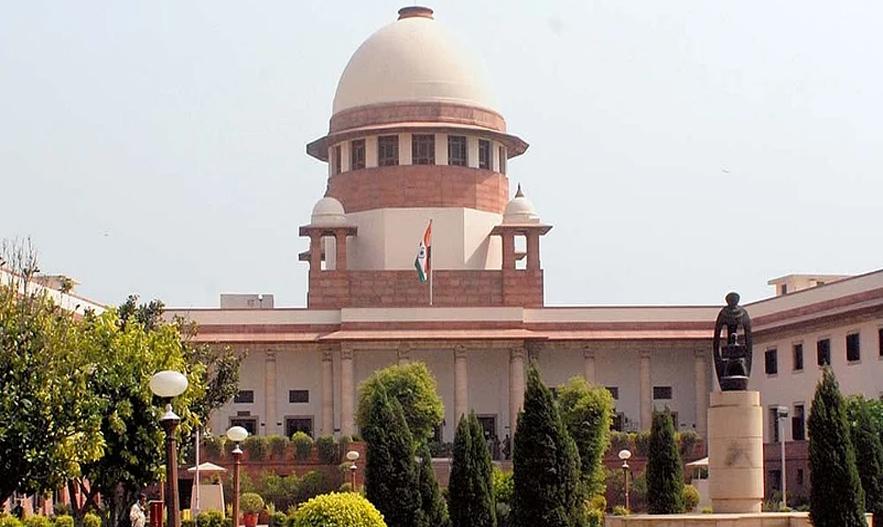
The Supreme Court on Monday directed the Centre to ensure encroachment-free space for walking on every road across the country.
A bench of Justices P S Narasimha and Alok Aradhe told Additional Solicitor General (ASG) K M Nataraj, appearing for the Centre, to instruct the authorities to demarcate pedestrian areas and ensure that the space meant for walking is not encroached upon."Without any big investment and construction, just ensure that proper demarcation is done of walkers' space. Wherever there is a road, there should be a walkers’ space. Do it with a rope or anything and ensure it is not encroached," the bench said and fixed the matter for further hearing after two weeks.
Meanwhile, the court granted the Centre two weeks time to issue instructions to the authorities concerned. It added that the pedestrians must have confidence that the designated space belongs to them and they can walk without fear of vehicles.
The bench earlier in its July 19 judgement said that a citizen's fundamental right to walk on a demarcated footpath is primary and shall have priority over movement by motorised vehicles. "It is integral to the right to movement guaranteed under Article 19(1)(d), read with Article 19(1)(a), Article 19(1) (b), Article 19(1) (c) and Article 21 of the Constitution of India. The fundamental right to walk will take within its sweep the right to demarcated footpaths," it had said.
The court had passed the judgement and made these observations and declarations while deciding an appeal in a motor accident claim. The top court pronounced the judgement in a case arises from an unfortunate incident where a tanker hit a 5-year-old son while he was on his way to school with his father.
The father then filed a compensation claim petition for Rs 25,00,000 to be considered by the Motor Accidents Claim Tribunal (MACT), but it awarded only Rs 7,82,000 with 6% interest. Following this, appeals were filed by both the sides, and even the compensation was further reduced to Rs 4,70,000 by the High Court. Then the father moved the SC for appropriate orders and compensation.
The top court then came to the rescue and had set aside the order of the HC, and held that the father would be entitled to compensation of Rs 11,44,628 to be paid within 2 months.
"The fundamental right to walk on demarcated footpaths has a correlative duty. If the road exists, there is a duty to ensure that there are demarcated and well-maintained footpaths for walkers. The duty bearers are the urban development authorities, municipal corporations, municipalities and even panchayats, who must endeavour to demarcate, construct, maintain, and safeguard footpaths and other necessary pedestrian infrastructure, as walking is integral to life," the bench had added.
Stressing on the necessity to establish a regulatory body, the court had said that such a regulator will develop and retain institutional memory so that it can act on the basis of the experience, data. and information it has gathered and processed. "Institutional expertise is critical, and such a regulator will employ human resources with domain expertise and talent. The regulator will maintain institutional integrity by taking independent and objective decisions without governmental or industrial control. These values shall flow naturally if there is institutional transparency and accountability. It is in this perspective that we need to effectuate the fundamental right to walk," the court had stated.
The judges also had clarified that the violation of the right to walk on demarcated footpaths will entitle the citizens to invoke constitutional and legal remedies against duty bearers for restitution and compensation. This remedy is independent of the remedies that are available under the Motor Vehicles Act, 1988.