
Iran and Oman are moving closer to an agreement to reopen the disputed Strait of Hormuz, a key shipping route that has been hit by months of conflict. Under the emerging plan, ships would enter the Persian Gulf through a route controlled by Iran and leave through one controlled by Oman, according to two regional officials. Any agreement appears to depend on the United States lifting its blockade on Iranian ports, even as the Trump administration has earlier ruled out any deal that would give Iran control over the strait.
Across the wider region on Tuesday, ships came under attack in the Strait of Hormuz and the Red Sea, Gaza City saw a mass funeral for more than 100 victims of an Israeli strike from early in the war, Israeli and Lebanese officials held talks in Rome on military withdrawal from southern Lebanon, Yemen’s Houthis claimed a strike on a Saudi airport, and families in Beirut marked six years since the 2020 port explosion.
Senior US officials indicated that a deal on the strait could come soon. Secretary of State Marco Rubio said there had been progress in talks between Iran and Oman, "but not finality yet". Treasury Secretary Scott Bessent told CNBC that "there is a chance we may have a deal today or tomorrow to open the strait and move towards a more normalised position in this conflict".
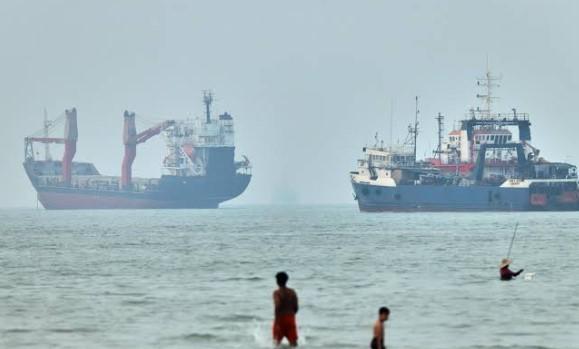
The Strait of Hormuz, at the mouth of the Persian Gulf, is a vital waterway through which a fifth of the world’s oil and natural gas passed before the war. It has effectively been shut by Iran’s attacks on shipping since the war began in February. Qatar’s emir, Sheikh Tamim bin Hamad Al Thani, said he also spoke to US President Donald Trump on Tuesday as Qatar tried to help broker a resolution. Al Thani’s office said the two discussed ways to bridge the divide "in a way that enhances the prospects of reaching a sustainable diplomatic settlement to the crisis".
A cargo ship reported being "hit by an unknown projectile" while passing through the Strait of Hormuz, according to the United Kingdom Maritime Trade Operations Centre. The centre said the strike damaged the vessel at around 2 am local time when it was about 37 kilometres northeast of Al Khasab, an Omani port city. It was not immediately clear which flag the ship was sailing under or whether it was carrying cargo, but British maritime security firm Ambrey also said it had sustained damage.
In the Red Sea, an Indian-flagged commercial ship sank off Yemen after being hit by an explosive-laden boat, according to Yemeni and Indian authorities. Yemen’s coast guard rescued the crew, which included 13 Indians and one Yemeni. India’s Foreign Ministry condemned the attack. No group immediately claimed responsibility, though Iran-backed Houthi militants have repeatedly targeted ships travelling through the Red Sea near Yemen.
In Gaza City, hundreds gathered as bodies wrapped in Palestinian flags were laid out in rows near flattened buildings before being carried on stretchers through a narrow street to a nearby cemetery. The 112 victims were among more than 300 people killed in an attack on the Sabra neighbourhood on November 22, 2023. First responders recovered the bodies over the weekend, including those of 40 children and 30 women, according to the Civil Defence, a rescue agency under Gaza’s Hamas-run Interior Ministry.
The Gaza war began on October 7, 2023, when Hamas-led militants attacked southern Israel, killing around 1,200 people and taking 251 hostage. Since then, Israel’s military offensive in Gaza has killed 73,375 people, including civilians and combatants, according to Gaza’s Health Ministry. Another 7,400 people are still missing and are believed to be buried under the rubble, according to Zaher al-Waheidi, head of the ministry’s records department.
Israeli and Lebanese officials met in Rome to continue talks on a US-mediated deal to reduce the Israeli military presence in southern Lebanon and disarm the Iran-backed Hezbollah group. A diplomat familiar with the negotiations said Lebanon had asked for the next "pilot zone" to be either Khiam or Bint Jbeil, both of which saw heavy fighting in the latest Israel-Hezbollah war and are now occupied by Israeli forces. But US Ambassador to Lebanon Michel Issa said before the three-day talks that no new pilot zones would be introduced immediately, warning that "moving too quickly risks jeopardizing the very civilians this process is meant to protect". Implementation of the June 26 agreement began last month with an initial pilot zone in an area that was not occupied by Israeli forces but had previously come under Israeli fire.