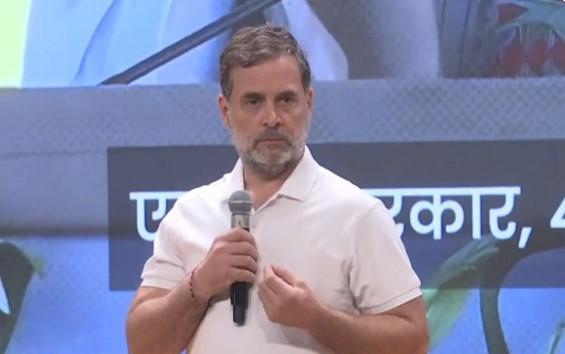

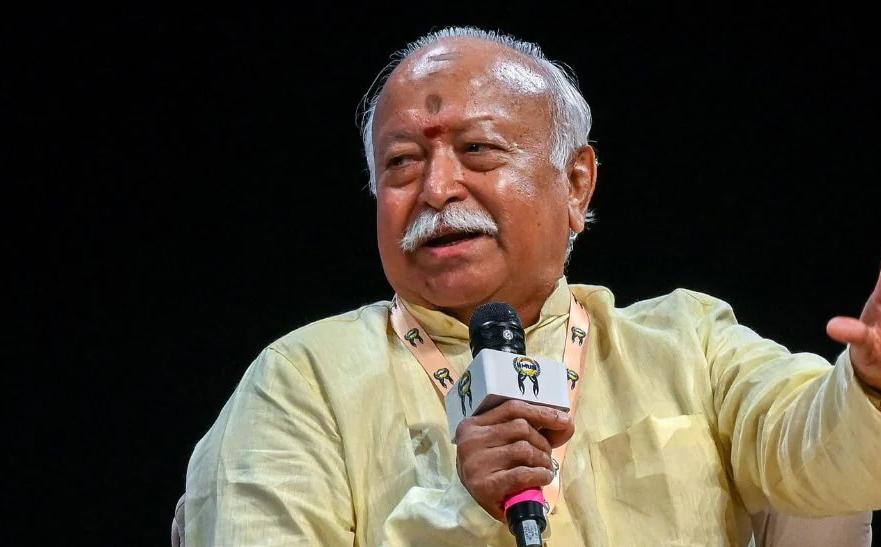
Rashtriya Swayamsevak Sangh (RSS) chief Mohan Bhagwat on Thursday strongly backed India's younger generation, saying he would "trust Gen Z blindly" and asserting that students taking part in protests should not be labelled anti-national.
Addressing around 2,000 Gen Z and Gen Alpha members at the 15th anniversary celebrations of India's International Movement to Unite Nations (IIMUN) in Mumbai, Bhagwat said the younger generation deserved to be heard through dialogue rather than judged for questioning authority.
"I want to make it clear that if Gen Z engages in any agitation, they are not anti-national. They are our own people; they are our next generation. A sense of belonging and mutual respect is needed for dialogue to take place. We need to recognise and respect each other. Only then can a meaningful dialogue happen, where we understand their concerns and they understand our perspective," Bhagwat said.
Describing today's youth as more honest than previous generations, he added, "I believe today's younger generation, Gen Z and Gen Alpha, is more honest than the existing generation. This generation should have honesty towards the nation, a spirit of patriotism, and a commitment to service."
Bhagwat reiterated his faith in young people even while acknowledging that he did not know the complete facts behind the recent confrontation between police and protesters.
"I will trust Gen Z blindly," he said. Referring to reports of the use of tear gas and pellet guns during the protests, Bhagwat said conclusions should not be drawn without verified information.
"If I had to believe, I will believe Gen Z. But we do not know the reality. Both of us are conversing on the basis of information available through reports. There have also been reports of some anti-social elements in this movement. But we cannot talk without authentic information," he said.
'WILL NEVER SAY GEN Z SHOULD NOT PROTEST'
Calling protest an integral part of democracy, Bhagwat said dialogue was essential to address genuine grievances.
"Protest is also one of the means of dialogue. Democracy is a way to make consensus after discussion. Grievance is genuine, and a lot has to be improved in our nation's education system. So dialogue is important," he said.
Drawing a contrast with previous generations, Bhagwat said today's youth are more willing to question authority.
"We never used to question authorities, but Gen Z and Gen Alpha question authority and want logical answers, that too with love," he said.
The RSS chief said he would never discourage young people from protesting. "I will never say that Gen Z should not protest, but there should also be a way given in democracy. We need to see that if youth is shouting, it is not for opposing but for improvement," he said.
He added that there were shortcomings in the system that needed to be rectified and that student protests seeking reforms should be viewed as a legitimate democratic exercise.
'A LEADER CREATES MORE LEADERS, DOESN'T SEEK THE SPOTLIGHT'
Bhagwat also outlined what he called the qualities of a true leader, saying leadership was not about delivering speeches, winning elections or standing in front of people, but about working quietly, sharing success and nurturing future leaders.
Referring to a Sanskrit verse, the RSS chief said an ideal leader should possess knowledge, recognise and appreciate the strengths of others, share success, fame and material gains with colleagues, and display courage like a warrior when faced with challenges.
"Real leaders are those who lead from behind. They work from within," Bhagwat said.
Rejecting the conventional notion of leadership, he added, "Leadership is not about standing before people, making speeches or winning elections. I do not see myself as a leader. I see myself as a worker."
Bhagwat said the ultimate purpose of leadership was not to build followers but to create more leaders.
"The purpose of leadership is to lead people towards light. The purpose of leadership is to create leaders. It is not to lead by myself. My leadership should create leaders," he said.
EDUCATION IS SOCIETY'S RESPONSIBILITY
The RSS chief devoted a significant part of his address to education, saying it should not become a commercial activity.
"Education is not a commercial business. Community help can improve the education system. The financial burden of education is huge. We need to be vigilant, active and assess the system regularly. We also need to train our teachers. It is not just the government's responsibility to educate, but a social responsibility," he said.
Backing a long-standing demand for greater public investment, Bhagwat said allocating six per cent of the national budget to education remained relevant.
"Demand for a 6% budget allocation for education is old. But only the government does not run schools. We as an organisation also strive hard for education and learning. There should be a social spirit awakening for education," he said.
LAW ALONE CAN'T FIX SOCIAL MEDIA
Bhagwat also spoke about the influence of social media, saying legislation alone could not solve the problem of misinformation.
"It is necessary to change the attitude. Only law enforcement is not enough. We need to change role models," he said.
He urged influencers with millions of followers to act responsibly and stressed the need to verify information through authentic sources.
"If something is banned, there will always be loopholes. So banning alone cannot be the solution," he said.
Questioning why violent content attracts greater engagement online, Bhagwat said, "Gen Z does not subscribe to violence, then why does violent content receive more likes? It needs to be thought about and analysed."
BHAGWAT ON TIES WITH PAKISTAN, CHINA
Speaking on national security and international conflicts, Bhagwat said citizens should support the government's decisions during crises while maintaining a humanitarian outlook.
"In times of conflict, we have to go with what the government does. Pakistan and China are two examples. The Indian solution is to hold back differences while dealing with conflicts. Permanent hatred is not the solution," he said.
"It is not that Pakistanis are wholeheartedly our enemies, and not even all Indians. Humanity has to be one," Bhagwat added.
ON LGBTQ, SAME-SEX COMPANIONSHIP
Bhagwat said members of the LGBTQ community were an integral part of society and deserved accommodation.
advertisement
"They are also part of our society, and we have a tradition to accommodate them," he said.
However, he distinguished marriage from companionship, saying marriage was a social institution rather than merely an arrangement for two people to live together.
"Marriage is not a convenience to just live together, but it is a unit of society. Families create good citizens. We need to have some system first. If existing systems are disrupted without creating new systems, there will be consequences," he said.
Emphasising that social norms shape legislation, Bhagwat said, "Law does not dictate society, but society dictates law."
He added that while he did not support same-sex marriage, society should evolve a framework to recognise same-sex companionship.
"We have to devise a system where not same-sex marriage, but same-sex companionship should be accommodated," Bhagwat said.
Bhagwat's remarks come amid a wider debate over student-led protests, police action and the role of democratic dissent, with the RSS chief arguing that India's younger generation should be engaged through dialogue rather than suspicion.